
Small Business Bookkeeping: 6 Tips to Get You on the Right Track
If you're a small business owner, bookkeeping probably wasn't the reason you started your business.
You started because you had a skill, a product, an idea, or a problem you knew how to solve. Then came the invoices, expenses, bank statements, receipts, payroll, taxes, and all the other financial details that somehow became your responsibility too.
That's where good small business bookkeeping comes in.
Bookkeeping isn't just about entering transactions into QuickBooks Online or making sure your accountant has something to work with at tax time. Your bookkeeping should help you understand how your business is actually doing.
Here are six small business bookkeeping tips that can help you get on the right track.
1. Separate Your Business and Personal Finances
This is one of the most important bookkeeping habits you can establish.
Your business should have its own bank account and, ideally, its own credit card. Business income should go into the business account, and business expenses should be paid from it.
Mixing personal and business transactions makes bookkeeping more difficult and makes it harder to determine what your business is actually earning and spending.
It also creates unnecessary work when you're trying to prepare your financial records for your tax professional.
If you're currently using one account for everything, don't panic. You can clean it up. But moving forward, make separating your finances a priority.
2. Know Where Your Money Is Going
It's not enough to know how much money came into the business.
You also need to know where it went.
This is where a properly organized chart of accounts becomes important. Your chart of accounts categorizes your income, expenses, assets, liabilities, and equity so your financial reports actually tell you something useful.
For example, if all of your expenses are lumped together, it can be difficult to see whether you're spending more on advertising, software, contractors, supplies, or other operating costs.
Good bookkeeping turns a pile of transactions into information you can use.
3. Reconcile Your Accounts Regularly
Your bookkeeping system should agree with your actual bank and credit card accounts.
That's what reconciliation helps you accomplish.
When you reconcile an account, you're comparing the transactions recorded in your bookkeeping system with the transactions reported by the financial institution.
Doing this regularly can help you catch missing transactions, duplicate entries, incorrect amounts, and other issues before they become bigger problems.
You don't want to discover in December that your bookkeeping hasn't matched your bank account since March.
4. Don't Wait Until Tax Season
One of the biggest bookkeeping mistakes small business owners make is treating bookkeeping as a once-a-year activity.
Your financial records should be maintained throughout the year.
When your bookkeeping is current, you can see your revenue, expenses, profitability, outstanding invoices, and cash position without having to reconstruct an entire year of transactions.
Year-round bookkeeping also makes tax preparation much less stressful because you're not trying to remember what happened 10 months ago.
5. Review Your Financial Reports
Your bookkeeping system can produce financial reports, but those reports are only useful if you look at them.
At a minimum, small business owners should become familiar with their:
Profit and loss statement
Balance sheet
Cash flow information
Accounts receivable
Accounts payable
You don't need to become an accountant.
You do need to understand what your numbers are telling you.
For example, your profit and loss statement might show that you're profitable while your bank account feels surprisingly low. That's not necessarily a contradiction. Profit and cash flow measure different things.
6. Create a Bookkeeping Routine
The best bookkeeping system is the one you actually maintain.
Set aside time each week or month to review your financial activity.
That might include:
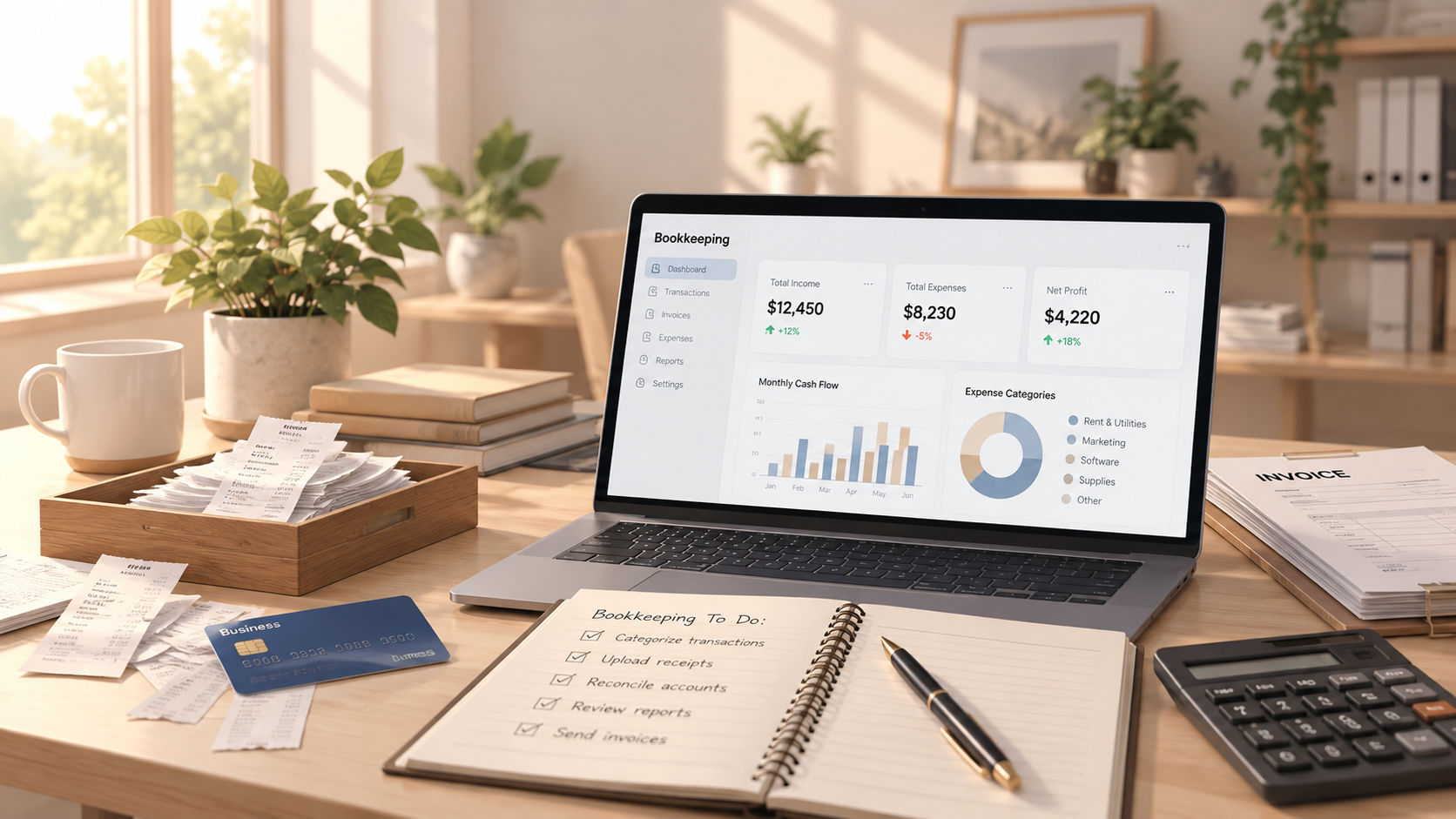
Categorizing transactions
Uploading receipts
Sending invoices
Reviewing unpaid invoices
Reconciling accounts
Reviewing financial reports
Following up on missing information
If bookkeeping consistently falls to the bottom of your to-do list, that's useful information too.
It may be time to consider outsourcing your bookkeeping.
What Should Small Business Bookkeeping Look Like?
There isn't one perfect bookkeeping system for every business.
A freelancer with a handful of monthly transactions doesn't need the same process as a growing service business with employees, contractors, multiple bank accounts, and hundreds of transactions.
The goal is to have a bookkeeping process that is accurate, organized, current, and useful for decision-making.
That may mean using QuickBooks Online yourself, working with a bookkeeper, or combining the two.
The important thing is that your financial records don't become an afterthought.
Final Thought
You don't need to love bookkeeping.
But you should know what's happening with your business financially.
Good small business bookkeeping gives you a clearer picture of where your business stands today and gives you better information to make decisions about where you want it to go next.
And if your bookkeeping is already a little behind, that's okay too. The goal isn't to have perfect records from day one. The goal is to get organized and create a system you can maintain going forward.
Aurrera Bookkeeping helps small business owners create organized, manageable bookkeeping systems so they can spend less time trying to figure out their numbers and more time running their businesses.
