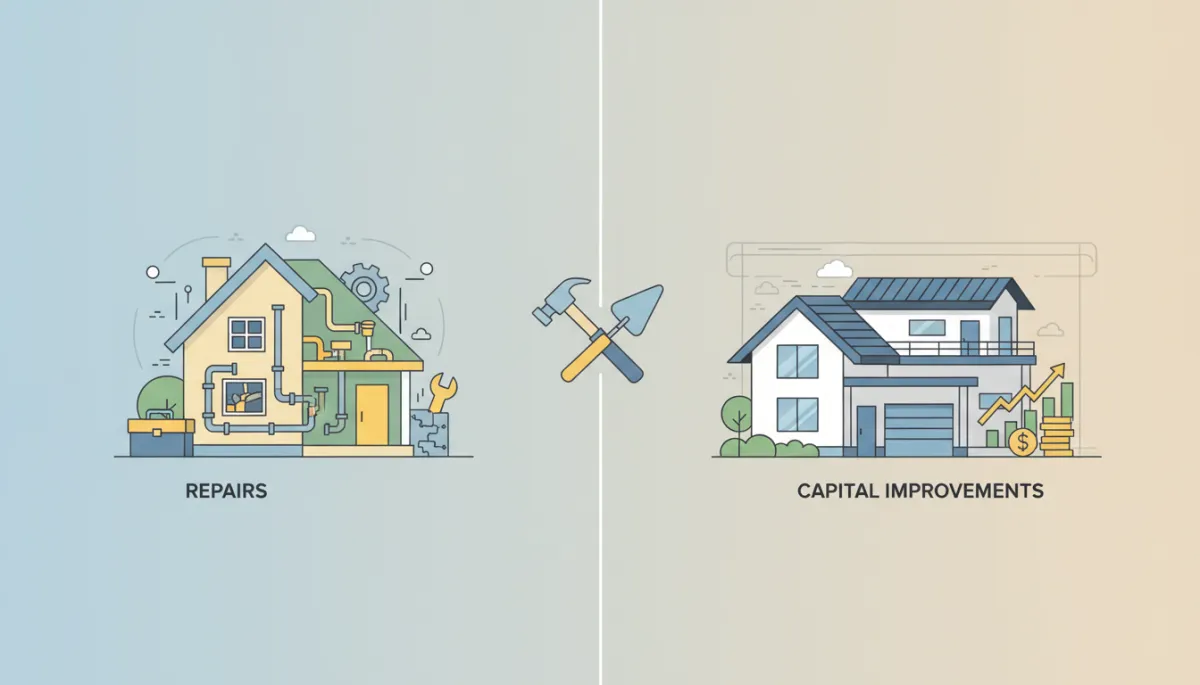
Repairs vs Capital Improvements for Investors
Real Estate, Tax Strategy, Property Management
How Real Estate Investors Can Tell Repairs from Capital Improvements
Understanding the difference between ordinary repairs and capital improvements is essential for real estate investors who want to maximize cash flow, stay compliant with tax rules, and make smarter long‑term decisions about their properties.
Why This Distinction Matters for Real Estate Investors
For real estate investors, every dollar spent on a property affects taxes, cash flow, and long‑term value. The IRS treats repairs and capital improvements very differently:
Repairs are generally deductible in the year you pay for them, reducing your taxable rental income immediately.
Capital improvements must be added to the property’s cost basis and depreciated over many years, spreading the tax benefit over time.
💡 Educational takeaway: Classifying work correctly is not just paperwork; it directly shapes your after‑tax return on investment.
What Counts as a Repair? A Practical, How‑To View
In simple terms, a repair keeps your property in ordinary, efficient operating condition. It fixes wear and tear without significantly increasing the property’s value or extending its useful life. When you are unsure, ask yourself:
Am I just fixing something that broke or wore out? Examples: patching a roof leak, replacing a broken window pane, fixing a leaky faucet, repainting a scuffed wall between tenants.
Does this bring the property back to its previous condition, not better than before? If yes, it usually leans toward a repair.
From a how‑to standpoint, smart investors:
Track routine repairs separately in their bookkeeping software.
Keep invoices that clearly describe the work as “repair,” “patch,” or “fix,” not “upgrade” or “remodel.”
Schedule preventive maintenance (HVAC servicing, gutter cleaning) to avoid larger projects that could be treated as improvements later.
What Is a Capital Improvement?
A capital improvement is work that better the property, restores it substantially, or adapts it to a new or different use. For investors, that usually means projects that:
Increase value – upgrading laminate countertops to quartz, adding a bathroom, finishing a basement into rentable space.
Extend useful life – replacing the entire roof, installing all‑new windows, replacing all plumbing lines in an older building.
Change how the property is used – converting a garage into an accessory dwelling unit, turning a single‑family home into a duplex.

Strategic capital improvements can justify higher rents and attract more qualified tenants.
A Simple Educational Framework: Repair or Improvement?
When evaluating work on your property, walk through this quick, educational checklist:
Scope: Are you fixing a small part or replacing an entire system? Replacing a few shingles is a repair; replacing the whole roof is a capital improvement.
Result: Does the property end up better than before, or just functional again? “Better” often points to improvement.
Longevity: Will the work benefit the property for many years? Long‑lasting upgrades are frequently improvements.
📌 Key takeaway for investors: Repairs help this year’s cash flow; capital improvements shape your property’s long‑term value and depreciation schedule.
Putting It All Together in Your Investment Strategy
Real estate investors who plan ahead use both repairs and capital improvements strategically. Routine repairs keep tenants happy and units rent‑ready, while carefully chosen improvements raise rents, reduce vacancy, and increase resale value. Work with a tax professional to apply these concepts to your specific situation, but use this educational framework as your day‑to‑day guide whenever you approve the next work order or renovation bid.
